
A few weeks ago, I began a very unique training situation.
Remi is a 6-year-old pit bull who was living with her 82-year-old owner here in Fort Worth. Her owner contacted me for training because they’ll soon be moving to the Virgin Islands, and there are a few things they need to do to prepare for the trip:
-

Remi rides home to my house for her first day of Board & Train to address her behavior issues.
Remi needs to be crate trained. Remi has never been in a crate in her life, and despite her owner’s best efforts, she was refusing to go in one now.
- Remi’s owner wanted her to be socialized. She hasn’t interacted with another dog since she was a puppy, but once they arrive in the Virgin Islands, she will be living with her owner’s daughter and her 100 lb, 1-year-old Doberman. It was important that they find out a bit more about how Remi reacts to other dogs before they get there.
- Remi is territorial. Although she’s never taken a swing at anyone, she regularly displays a lot of barking and carrying on when she feels territorial. They weren’t sure if this was something that would carry forward to the Virgin Islands, and if she would react this way toward dogs, too.
- Remi pulls like a freight train on the leash. Her owner is in pretty good shape, but despite the Gentle Leader and the harness her owner was walking her on, she still couldn’t manage her.
When I arrived to evaluate Remi and meet her owner for the initial consultation, I immediately noticed that Remi was severely overweight. Pit bulls are frequently “big boned” but this was far beyond a stocky build! Remi was about 15-20 lbs overweight. She was a wide-eyed, panting, anxious mess as I entered the house. She did eventually collapse at her owner’s feet as we sat down to talk, but if she had been in better shape, I’m sure she would have continued to pace around.
The decision to do a Board & Train program
In-home dog training is the dog training format I most commonly utilize, and the one I believe holds the most value – far more than any other format. In-home dog training can be successful for any behavior issue, and Remi’s issues are no exception. During our initial consultation, I discussed with Remi’s owner the effort that would be required to train her. Although her owner was ready and willing to do any work required to help Remi, she also expressed doubts about her physical ability to handle Remi. We also discovered that her timeline was shorter than I thought – she had only 5 weeks until the big move!
An experienced dog trainer can account for either variable, but both variables at once pushed beyond the limits of in-home dog training. So, we made the decision to do a 10-day board and train program, and then we would follow up with weekly in-home dog training lessons until they depart.
Advantages of a Board & Train program
The advantage of a board & train format is that the trainer does all the “work.” In Remi’s case, she has had an entire six years of momentum behind her current behavior patterns. It’s certainly not impossible to overcome this (you can teach an old dog new tricks!), but it takes a bit of patience and persistence.
This “work” is best done by the dog’s owner. It gives the owner a chance to experience first hand the training process, and therefore gain a more thorough understanding about how to change dog behavior. This means that later on down the road, either with their current dog, or their next, they will understand how to change a behavior problem on their own, without the help of a trainer. What an advantage!
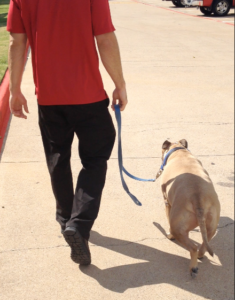
Dog training creates a bond between the dog and the handler… wouldn’t you prefer that handler be you?
Another important advantage is that the owner and their dog are learning and growing together. In our human-to-human experiences, when you go through a challenging experience with someone, it creates a unique bond. Our human-to-dog experiences are oddly similar. When you go through the process of behavior rehabilitation with your dog, a unique bond blossoms. So, sure, it’s easier to have the trainer do the “work,” but why would you want to miss out on the opportunity to bond with your own dog? After all, your dog will return home and live out his life with you, not with the trainer.
All that said, sometimes it just isn’t possible for the dog’s owner to do the work, like in Remi’s case. This is rare, but it does happen, and that’s when I utilize a combination of a board & train program and in-home dog training.
Drawbacks of a Board & Train program
Why the combination of in-home training with a board & train? Good question. Board & Train, on its own, is a limited dog training format. It’s limited because it leaves out two extremely important variables that have incredible influence over a dog’s behavior: the dog’s relationship to its owner, and the dog’s associations to its home environment. Without addressing these two factors (and a board & train program on its own does not), a dog will soon return to his old behavior patterns once he’s back home with his family.
When your dog is trained outside your home, whether its in a group class, or a board & train program, or a day training at day care, etc., he develops associations with that environment. This is certainly not harmful, but that environment is not your home environment. You still need to teach your dog how to behave in your home.
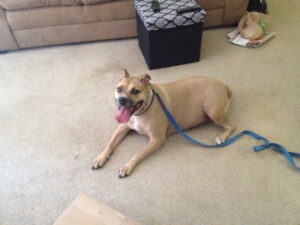
Remi on her first day of training… ever!
It is also important to recognize that when you pick up your dog from a board & train program, your dog is not “fixed.” By that logic, I could “fix” most dogs in less than a day. That’s why you see pictures and videos of dog trainers doing things like taking aggressive dogs out in public after just days (or hours) of working with them.
You are missing some, or all of the information and skills needed to change your dog’s behavior, which is why you need a trainer in the first place! Truly, a dog trainer’s job is to train you! That phrase has become somewhat cliche these days, but it’s still true. My job is to teach you how to influence your dog’s behavior so that no matter what situation you’re in (at home, at a local park, at the vet, at a sporting event, etc.) you can teach your dog how you’d like him to behave.
In Remi’s case, this is why we have decided to utilize a combination of a board & train program and an in-home dog training program. I can accomplish a LOT in 10 days, but unless I teach Remi’s owner these new skills, nothing really changes once Remi goes back home.