
This past weekend, I spent some time at the pool with a friend of mine and her 7-year-old twin daughters. She made a comment that really struck a chord with the dog trainer in me. I had mentioned how lucky they are to have access to such a great pool and she said, “Yeah, we go to the pool all the time! It’s the perfect way to drain their energy.”
Interesting.
Isn’t it interesting that we are aware that our children will act out when they have too much pent up energy, yet we often fail to draw that same correlation for our dogs?
Lack of exercise can lead to many behavior problems for dogs, just the same as children. With dogs, you may have to be a bit more intentional with the way you meet their exercise needs. Here are three important points about exercising your dog:
1. Dogs are animals (some people would argue that kids are also, but that’s for another time!). Animals are made to move! If you let your dog out the front door and he was on his own, guess what he would do? Walk. Run. Explore. Play. Maybe even hunt. Modern dogs are a bit lazier than their predecessors (thank goodness), but they still need exercise. Every. Day.
Before you write your dog off as lazy, take a minute to acknowledge the animal in him. Take him for a short walk, play ball with him, or encourage him to run around the yard. Every dog is different and therefore comes with different exercise needs, but every dog is still an animal. Don’t forget.
2. Be intentional with how you provide exercise. When I first meet a client, I ask how they exercise their dog. Most people look a little confused, and then reply that he mostly runs around in the backyard for exercise. This is not a bad thing, but this is not enough.
We tend to assume a dog will meet his own exercise needs if we just provide access to the yard. While this is true for some dogs, it is not true for most. Letting him out in the backyard is great activity for a dog, but it probably isn’t enough. Your dog doesn’t understand that this is his chance to drain his energy. He will entertain himself, but he doesn’t “work out” out there. He barks at the neighbors, paces, digs holes, takes a nap in the sunshine, etc. While some of these things can be classified as “activities,” they aren’t “exercise.”
So what is exercise?
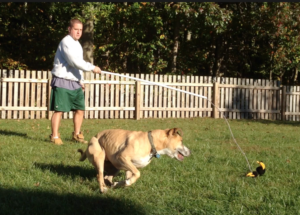
This dog is getting some energy out by playing flirt pole, a game that is both physically and mentally stimulating (when done appropriately).
Put the word engaged in front of exercise, and it’ll instantly redefine your view of how to exercise your dog. Engaged exercise. Engaged. This means you’re involved, and you’re keeping your dog moving. Walking, playing fetch, playing flirt pole, down on play (red light, green light for dogs), etc. are all good examples of engaged exercise.
The best exercise is both mental and physical. Be creative!
3. No exceptions. You can explain to your children that it’s raining outside, or that mom has a migraine and needs to relax, or that we’ll go to the playground later today after we get some things done around the house. However, your dog doesn’t get it.
Your dog needs exercise whether it’s convenient or not. I’m not trying to be mean, but this is a tough love moment. Like it or not, dogs don’t understand our exceptions. They can’t reason. They can’t “figure it out.” We tend to give them way too much credit for their perceived ability to reason (an ability they don’t really have) and then we get frustrated because they aren’t being understanding of our needs. Dogs are intelligent and complicated, but they’re more simple than you think!
Exercise isn’t the be-all and end-all of behavior problems, but lack of adequate exercise can absolutely create behavior problems. Unfortunately, recommitting to meeting your dog’s exercise needs may not be enough to get rid of a behavior problem.
Once established, behavior problems may persist despite adequate exercise. This is normal. If your dog has been practicing a bad behavior for a period of time, it just becomes part of his normal behavior patterns. Therefore, he may continue doing it even though he no longer has the pent up energy that contributed to the problem in the first place. This is where behavior training comes into play. That’s what I do, so if you need help, call me at 800.649.7297. If you’re not in the DFW area, visit Canine Trade Group to find a trainer in your area who can help!
For now, get out there and go for a walk… and have fun!