
Pepper and her teenage owner, Charlotte, have a very special bond. From the moment they met at a PetSmart adoption event, it was love at first sight! This beautiful canine-human bond has only grown stronger with time, and with training.
Pepper had supported Charlotte through some trying times, which inspired Charlotte to consider training Pepper as a service dog. They completed several levels of PetSmart training, but there was still one problem: Pepper’s behavior around both dogs and children was growing more and more alarming by the day.
Leash Aggression, Child Aggression, Dog Aggression… Oh My!
Many of Pepper’s behavior problems were occurring while out and about on the leash. Whenever Pepper would see another dog, she would fixate, and then barking and lunging were sure to follow. This behavior also occasionally emerged with people, and most alarmingly, with children. The few times that kids were allowed to approach her at the pet store, she would bare her teeth, bark aggressively, and even snap at them.
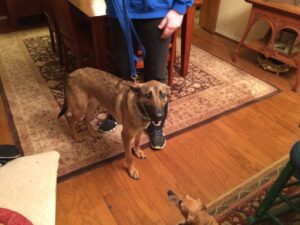
Pepper just before her first in-home dog training lesson here in Dallas.
Needless to say, Charlotte and her family were very concerned. Pepper had already been returned to the rescue once, and the family didn’t feel she stood a good chance if they returned her again. They wanted desperately to find a way to keep her safe and happy, but there were other problems emerging…
Pepper’s family has two older, smaller dogs. Initially, Pepper coexisted with them just fine, but recently, Pepper and the younger of the two (age 11) got into a few scuffles. In fact, the dogs decided to show me first hand on the night of our behavior consultation! It was clear that Pepper’s aggression was escalating, and that something needed to be done.
The First Step: Building a Relationship of Trust & Respect
Charlotte and Pepper already worked well together thanks to all the time they’d spent training prior to meeting me. They’d even phased away from using treats for many of her commands. However, Pepper was still very preoccupied with everything that was going on around her, and clearly felt the need to “handle” these situations herself.
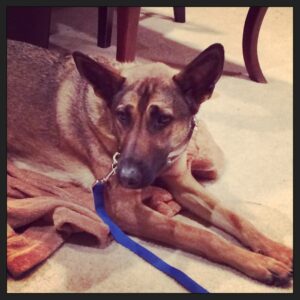
Pepper learning to relax in her place.
A huge part of lasting behavior change relies upon building the relationship between dog and owner. For dogs with a behavior problem, it isn’t enough for the dog to associate her owner as the giver of treats, petting, and snuggles. Now, there is absolutely nothing wrong with these things (nothing at all!) and these aren’t even things you need to give up or minimize while training your dog. (Yes, you can have your cake and eat it, too!) However, to change your dog’s behavior, your dog will need to understand that it’s not her job to handle these stressful situations, and instead, she needs to learn to trust that you will handle these situations for her.
Our first step with Charlotte and Pepper was exactly that: we simply took the strong bond they already had to the next level. During this initial training phase we also made sure Pepper and Charlotte had their basic skills down pat, including sit, stay, down, heel, and place.
The Next Step: Distraction Proofing, A.K.A. “Looking for Trouble”
Now that Pepper and Charlotte were working together like a well-oiled machine, it was time to put their new skills to the test! Pepper was already a rockstar in the house; in fact, her aggression toward the other dogs in the house was now completely under control, and the other dogs were feeling more and more comfortable around her with each passing day.

Pepper and Charlotte pass workmen during their third dog training lesson. Pepper normally would have reacted, but with great direction from Charlotte, she was able to stay calm and quiet!
Our first attempt at “looking for trouble” was to go out and about in a lightly distracting environment. During a walk in their neighborhood, we conquered many distractions that were previously triggers for Pepper’s aggressive behavior, such as workmen, kids on bikes, and other dogs walking. I was able to give Charlotte some critical feedback to fine tune her communication techniques with Pepper. We also implemented a desensitization strategy, and taught Charlotte how to read Pepper’s signals to determine what approach she should use in each real-life situation.
On our next lesson, we met at their local dog park – a former favorite spot of Pepper’s, and also the scene of the crime for several of her aggressive interactions with other dogs. Again, I was able to give Charlotte real time feedback on her interactions with Pepper, and teach her the strategies I use to help dogs acclimate to stimulating environments.
The entire goal of my training protocol is to make sure the dog’s owner(s) knows how to handle their dog safely and successfully in any situation… we were well on our way!!
For our final lesson, we went to the mother of all distractions: a local park with a “splash pad” (an open water fountain area for kids to play in), several playgrounds, pavilions, sports fields, joggers, walkers, and of course, other dogs on leashes.
Here, Charlotte and Pepper did FANTASTIC! By this point Pepper had her expected behavior patterns down pat (not a single sign of discomfort around all the running, screaming children!), and Charlotte had nearly perfected the art of communicating with Pepper, and safely navigating public environments.
I am so proud to say that thanks to all of Charlotte’s hard work, Pepper now knows how to make better behavior choices in these situations. Charlotte and her family know how to communicate with Pepper, and they’ve learned the strategy to set Pepper up for success in nearly any situation they encounter. Well done!!