
Puppy training is all about being proactive. When a puppy is young, you have a huge opportunity to shape his behavior into the kind of behavior you want him to display as an adult dog. This is easy to do, but also easy not to do. That’s what makes it so tough.
In this two-part article series, I’m going to discuss two different scenarios for puppy training. First, we’ll talk about what puppy training looks like when it’s going well. Then in our second article, I’ll discuss what happens when puppy training isn’t going well. What’s happening, what’s missing, what to do to fix it, and the question everyone wants to know: when is it a lost cause?
So first, let’s talk about puppy training at its finest.
What Does A Puppy Really Need?
By far, the most challenging aspect of puppy training is getting past cute and cuddly. If everyone could see past this, puppy training would be a non-issue. We’re human, so we struggle with this.
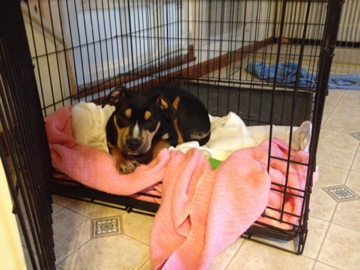 For many of us, a cute, cuddly, helpless little puppy seems to trigger some greater need to play caregiver. We approach a puppy as we’d approach a baby, often going so far as to refer to our puppy as “my baby” (ruh-roh). Your puppy does need a lot of care – puppies need to be fed several times a day, let out frequently, exercised, socialized, and guided through the world.
Wait, did you say ‘guided’? Yep, your puppy needs guidance!
In fact, I’d go so far as to say the number one thing your puppy needs is guidance. Not love, not affection, not socialization. Okay, okay, I’ll say guidance is number two… food is mandatory for survival, so lets go with food as number one.
What does guidance mean? Guidance is more than teaching basic obedience commands. Guidance is a proactive approach to your puppy’s behavior. It involves taking the initiative to show your puppy how you want him/her to behave, including taking away opportunities for bad behavior. It’s not something you practice for 20 minutes a day, it’s a lifestyle. It’s taking responsibility for your puppy’s future behavior by taking the intiative to shape his/her behavior now.
Puppy Training Is A Lifestyle!
There’s lots of things to teach a puppy: basic obedience skills, housebreaking, manners, etc. There are puppy classes designed to give you an overview of puppy raising, teach basic obedience, and socialize. With all these options, you’d think we’d have it covered; we don’t. Here’s the missing link:
Dogs are always in training. I have this discussion with every new client, regardless of whether their dog is a puppy or an adult. See, dogs aren’t able to think through our actions (or their own). They’re very bright, but they can’t reason. They can’t extrapolate from a single training session that this is how they should behave all the time.
Put differently, dogs don’t understand exceptions, so we absolutely must be consistent. They don’t know that it’s okay to jump in this scenario, but not that one. It’s okay to nip this person, but no one else. It’s okay to run around like a maniac, but only until it “goes too far.” Without the ability to understand an exception, your puppy easily gets confused about what exactly the rules are. If you’re at all inconsistent (i.e. making exceptions), you’re muddying the waters.
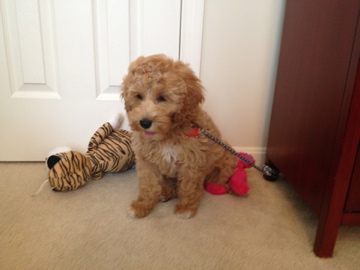 An easy example of this is the command ‘sit.’ I don’t know what it is about sit, but everyone seems to have their own way of teaching it – different hand signals, tone of voice, body language, timing requirements, etc. This is also true for members of the same household. You’ll have one family member use an upward hand motion while facing the dog and speaking in a high-pitched, sing-song voice, and the other family member frantically repeating “Sit! Sit! Sit!” as she leans over the dog and dangles a treat in the air. The end result of this major inconsistency: your puppy is confused. The command is unclear, and so their response is irregular especially once food rewards are out of the picture.
This is true for basic obedience commands, and it’s also true for every day behavior. While running around the house like it’s their own personal dog park, your puppy gets one of two responses from you. Either you’ll shrug it off as “oh well, he’s just a puppy. I guess he has to get that puppy energy out somehow,” or when you’ve had enough, you’ll try to get control, usually by yelling “GET DOWN! SIT! SIT! SIT! COME HERE! NO! BAD DOG!” I think we’d all agree these responses are conflicting. If I was on the receiving end, I’d be confused, too!
Proactive Puppy Raising
What’s missing from the above scenario with the puppy bouncing around the house? Guidance. We should take the time to teach the puppy how he should behave in the house.
How to do this?!
The leash is the mother of all proactive training tools for young puppies. Simply keeping your dog with you on a leash goes a LONG way toward establishing good behavior patterns.
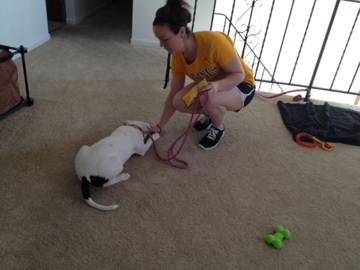
Nicole and Willow practice the down command.
For example, let’s look at the case of Nicole and Willow. Nicole adopted Willow as an 8-week-old puppy. Willow was previously in the care of a rescue group, and no one was sure of her background. Nicole wanted to make sure she did everything she could to help Willow grow into a physically and behaviorally healthy young dog, so she started “training” very early.
Nicole called me for puppy training when Willow was about 16-weeks-old. She was excitable, as all young puppies are, but I was impressed with how quickly she calmed down. She was able to relax beside Nicole within about two minutes. Most adult dogs I meet for the first time can’t do this!
As we talked about Willow’s lifestyle, we discovered that Nicole was already doing a lot of puppy “best practices.” Nicole crates Willow when she isn’t able to supervise her (like when she’s not at home, in the shower, etc.). Willow is very accepting of her crate and is calm and quiet when she’s in it. Nicole walks Willow daily and although Willow still pulls a little and she barks at other dogs, she is coming along pretty well. Willow also gets lots of playtime and interaction at doggie daycare a few days a week. Nicole has been working with Willow on her basic commands, and she can reliably sit and lie down for treats. Finally, and most importantly, Nicole keeps Willow on the leash when guests first arrive. She also puts her on the leash whenever Willow gets too wound up, or when they’re in a new situation.
Without realizing it, Nicole was already doing the number one thing should could do to help Willow develop into a well behaved adult dog. We tweaked their lifestyle a little to maximize these results – I had Nicole keep Willow on the leash more often, and we taught Willow the place command and used it frequently. I explained to Nicole how to use the leash to keep Willow out of trouble, and to guide her into better behavior choices. We also started working on recall and began to build “stay” into the sit and down commands.

Nicole guides Willow to proper leash manners early on in life to prevent any issues later on.
Finally, we needed to address Willow’s leash behavior. Training is anything done consistently, right? If she’s consistently reacting to other dogs at 4 months of age, what will this look like at 6 months? We spent about 30 minutes teaching Willow how to not just walk with, but follow Nicole (big difference). Willow caught on quickly, and it didn’t take much for Nicole to explain to Willow that she should stay focused on following instead of reacting to other dogs.
Nicole was proactive in her initial puppy raising practices, and thanks to her hard work and the tweaks we implemented during our training sessions, Willow is now set up for success as an adult dog. All Nicole has to do is remain consistent and Willow will grow into good behavior choices!
Stay tuned for Part 2 of our Puppy Training Series and in the meantime, follow this puppy training advice and your puppy can start off right like Willow!